
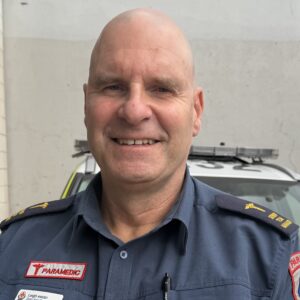
Leigh Branagan
Ambulance Victoria
Leigh Branagan is an ALS Senior Team Manager with Ambulance Victoria, bringing 27 years of frontline and leadership experience to the organisation. Leigh oversees operations within the Melbourne LGA, providing strategic and operational leadership to several specialised units, including the North Melbourne Ambulance Branch, the Mobile Stroke Unit, Paramedic Motorbike Unit and the Manual Handling Unit.
Throughout his career, Leigh has contributed extensively across diverse areas of Ambulance Victoria. His experience spans Specialist Operations and Coordination, Emergency Management, and Regional Operations, where he has played a key role in strengthening service delivery, operational readiness, and organisational capability.
Equity in stroke management –pre-hospital innovations improving stroke care for all Australians.
Mr Grant Hocking ASM1
1Australian Stroke Alliance, 2Ambulance Victoria
Abstract:
This presentation will explain how the Australian Stroke Alliance (ASA) is collaborating with prehospital carers and ambulance services across Australia to transform the delivery of urgent, life-saving prehospital stroke care.
It will explore what is being achieved through the introduction of new models of care, the use of improved communication methods and preparation for the introduction of world-first portable brain imaging devices.
Stroke is a time-critical emergency with 46,000 Australians of all ages experiencing a stroke every year. Treatment relies on knowing if a patient has had a bleed in their brain (20%) or a clot (80%). International best practice is to deliver clot-busting treatment within 60 minutes (the Golden Hour) of hospital arrival.
The ASA is determined to improve the speed of care for regional Australians who are 17 per cent more likely to experience a stroke than their metropolitan counterparts, and who have less access to urgent care.
New Stroke-smart ambulances will incorporate new models of care and video consultation allowing paramedics to share patient details with a Tele-neurologist and collaborate on time-critical treatment and decisions including potential bypass of smaller hospitals to a major stroke treatment centre.
The technology will also allow Emergency departments and other hospital staff to monitor the patient’s clinical condition and prepare for their arrival. Imaging equipment and theatre teams are primed, to fast-track CT scans, diagnosis and life-saving treatment.
The future introduction of portable brain imaging devices will further enhance the capacity to diagnose and treat patients much earlier.