
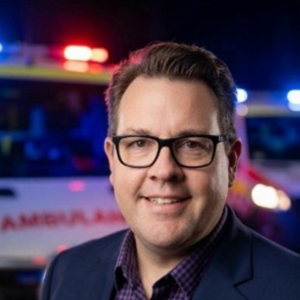
Dr Buck Reed
Charles Sturt University
Dr. Buck Reed is Lecturer in Paramedicine at Charles Sturt University with over a decade in academia and 19 years of clinical practice. He is a Registered Paramedic in Australia with both rural and metropolitan experience. Buck’s research focus is the intersection of paramedicine and social sciences, wellness and professionalisation.
Towards a scaffolded, evidence-based wellbeing curriculum for students in an undergraduate university degree program
Dr Buck Reed1
1Charles Sturt University
Abstract:
Over the past two decades, paramedicine in Australia and New Zealand has transitioned from a post-employment, academy-based education model to a pre-employment, university-based degree model. During this period, the paramedic student population and workforce have become increasingly diverse, with many entrants bringing existing wellbeing challenges such as neurodiversity, lived experience of trauma, and diagnosed functional conditions.
Historically, wellbeing education was largely viewed as the responsibility of employers. Increasingly, however, wellbeing is recognised as a core paramedic capability that must be developed prior to workforce entry. As a result, universities now play a critical role in building students’ wellbeing capabilities and preparing them for the demands of clinical practice.
In response to this need, Charles Sturt University has developed an evidence-based framework that embeds wellbeing education across the entire paramedicine degree. The framework is designed to better prepare students for the paramedic workforce and aligns with both the University’s broader wellbeing strategies and existing industry approaches. It delivers a graduated wellbeing curriculum structured around eight key wellbeing domains, beginning with wellbeing literacy and culminating in more advanced concepts of wellbeing leadership.
The overarching aim of this framework is to fully integrate wellbeing throughout the paramedicine program and produce graduates with well-developed wellbeing capabilities. Its development involved a comprehensive evidence-based review of contemporary wellbeing strategies, alongside consultation with an expert panel comprising industry and clinical professionals. Implementation of the framework commenced with first-year students in 2026 and will be progressively rolled out in line with Charles Sturt University’s new paramedicine curriculum.
Understanding Generalism and its Impact on Paramedic Roles and Identity
Abstract:
Modern paramedicine has developed specialist roles over the past six decades. Historically, these roles emerged to deliver more technically advanced care to specific patient populations. Specialist roles have also tended to attract greater power and prestige within paramedic practice and are often viewed as a natural pathway for career progression. In addition, they have frequently conferred cultural status on groups of practitioners within organisations.
More recent developments in paramedicine have increasingly focused on primary and community health contexts, areas which have traditionally relied on generalist practitioners. Roles such as community paramedics, urgent care paramedics, and practice paramedics working with general practitioners depend on clinicians with both breadth and depth in knowledge and skills. Importantly, paramedicine at its core is a generalist profession. Its emphasis on undifferentiated problem-solving, whole-person care, sense-making, and clinical pragmatism aligns closely with established theories of medical generalism.
Theories of generalism also provide a framework for understanding advanced practice and for situating it more clearly within the profession and the broader healthcare system. Many advanced practice roles may rely primarily on enhanced generalist capability—such as the proposed Advanced Practice Paramedic endorsement—rather than narrow specialty practice in the traditional medical sense. Moreover, despite their nomenclature, many traditional paramedic roles may be more accurately understood as forms of advanced generalism rather than specialty practice. Understanding and embracing paramedic generalism helps to cement the professional identity of paramedics and supports the identification of the most effective roles for paramedics within the community.