
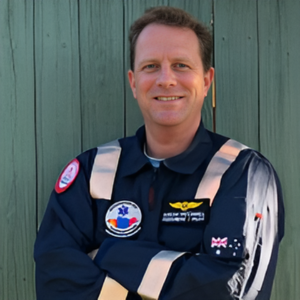
Duncan has worked in prehospital care and emergency services since 1997 starting off as a volunteer and progressing through to Senior Management and Director roles to date. Duncan’s experience has spanned both metropolitan, rural, military, private industry, international service delivery and aeromedical ambulance operations, in the capacity of a paramedic, educator and managerial/leadership responsibilities. In 2014 Duncan developed and rolled out the Griffith University Paramedicine Degree and was their Foundational Program Director. Since 2017 Duncan has been working with the Ministry of Health, Republic of the Maldives, Ministry of Health Mongolia, the World Bank and the World Health Organisation (WHO) to enhance and develop healthcare delivery. This work has included the ground up development of the new National Ambulance Service (Maldives) and the redevelopment of and introduction of national standardisation for the Mongolian Ambulance Service and disaster management response. This development work has taken on a truly globalisation approach with Duncan involving experts from Australia, Canada and USA to help deliver and develop innovative and life changing healthcare delivery methods and standards in low and middle-income countries. Duncan is also a sitting member of the Global Paramedic Higher Education Council™(GPHEC), a Board Director with the International College of Advanced Practice Paramedics (I–CAPP), and an active paramedic practicing across both acute and primary healthcare roles in both Australia and Internationally.
The foundations of primary healthcare being introduced into undergraduate paramedic education; a student’s perspective
The delivery of prehospital emergency care is evolving globally, with ambulance services adopting diverse approaches. While some services maintain a universal response model for all emergency calls, others have transitioned to specialised systems that match specific resources and units to different call types.
This evolution coincides with a significant shift in paramedic education, as degree-entry requirements are becoming the standard pathway into the profession. This raises important questions about how educational institutions can best prepare future paramedics for success in this changing landscape.
Griffith University has embraced this challenge by redesigning its paramedic degree program to emphasise primary healthcare foundations. A key innovation is the integration of “Community Paramedicine” clinical placements for both second and third-year students. This structured approach provides valuable opportunities for students to develop their clinical reasoning skills at different stages of their education. Student feedback has demonstrated clear progression between placements, with third-year students showing enhanced understanding and more sophisticated clinical approaches compared to their second-year experiences with similar cases.
This presentation will provide an overview of the program, followed by insights from two third-year paramedic students sharing their experiences with this innovative educational approach.